How Hot Should a Sauna Be? Temperatures in °F and °C, Humidity and Heat-Up Times
By the Sauna Advice editors 7 min read Updated November 26, 2026
Worth remembering
- Traditional saunas: about 150 to 195 °F (65 to 90 °C) at the thermostat.
- Harvia calls 149 to 176 °F (65 to 80 °C) a suitable room temperature.
- UL-listed US heaters commonly stop at 194 °F (90 °C); Harvia calls over 100 °C too high.
- Infrared cabins usually reach about 115 to 140 °F; Clearlight quotes 115 to 125 °F.
- Air at the upper bench can be 50 °F cooler than at the ceiling above the heater.
- Electric rooms take about an hour to heat; infrared cabins 10 to 15 minutes.
In this guide
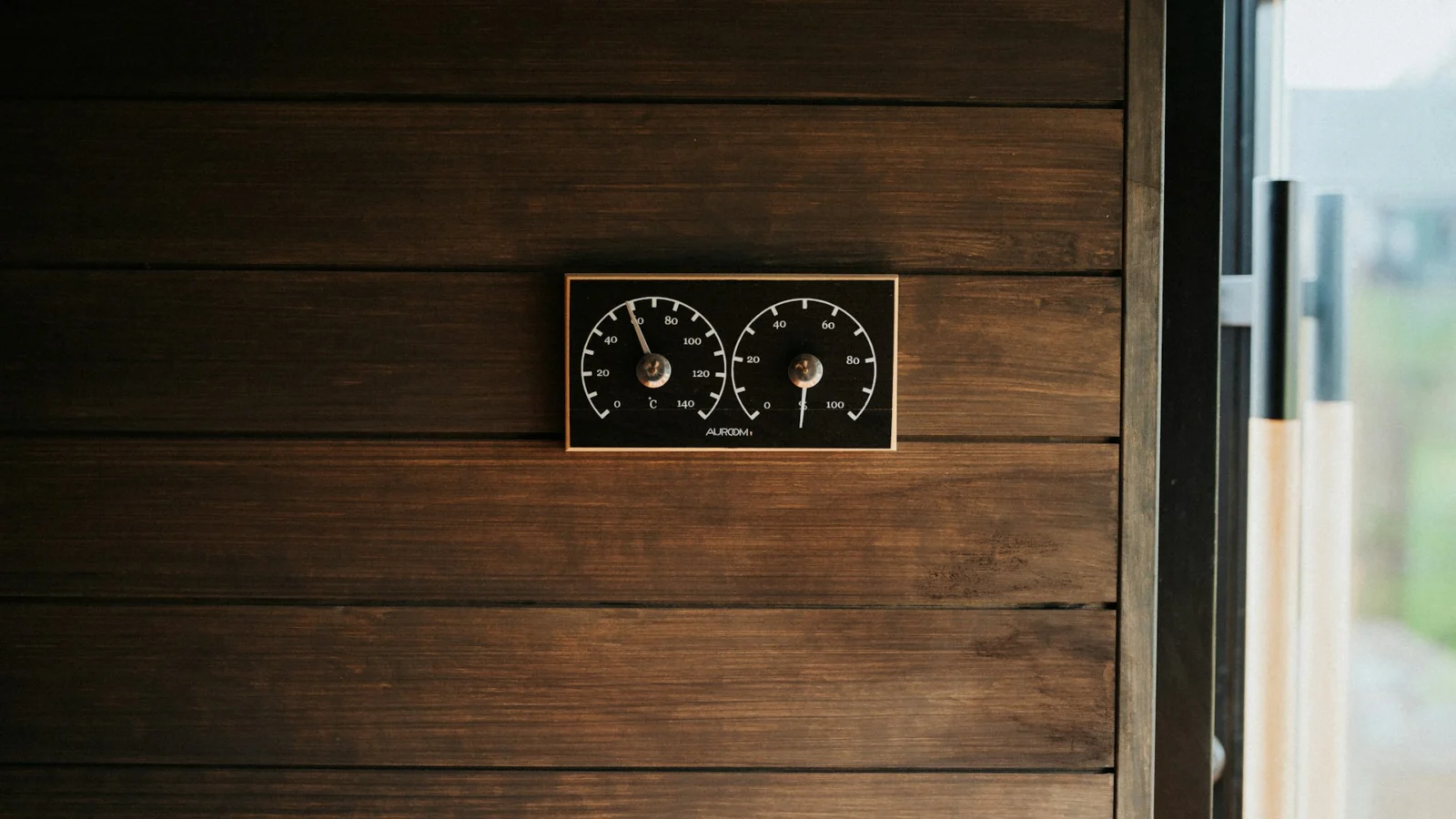
A traditional sauna is usually set between about 150 and 195 °F (65 to 90 °C). Harvia’s US owner’s manual calls 149 to 176 °F (65 to 80 °C) a suitable room temperature, HUUM suggests starting at 140 to 158 °F (60 to 70 °C), and UL-listed heaters sold in the US commonly cap the thermostat at 194 °F (90 °C). Infrared cabins run much cooler, about 115 to 140 °F.
The number on the dial is only half the story. The thermometer sits high on the wall, where the air is hottest, so the bench where you sit is often 30 to 50 °F cooler. And once you throw water on the stones, the heat you feel rises sharply while the thermometer hardly moves. The right temperature is the one where you can stay comfortably for a round and want to come back.
Sauna temperature chart in °F and °C
| Setting | °F | °C | Source |
|---|---|---|---|
| Infrared cabin, typical | 115 to 125 | 46 to 52 | Clearlight FAQ |
| Infrared cabin, range across makers | 100 to 149 | 38 to 65 | HUUM |
| Traditional, beginners | 140 to 158 | 60 to 70 | HUUM |
| Traditional, suitable room temperature | 149 to 176 | 65 to 80 | Harvia Virta US manual |
| Traditional, typical range | 158 to 212 | 70 to 100 | HUUM |
| Common US thermostat cap, UL-listed heaters | 194 | 90 | Redwood Outdoors, SaunaFin |
| Too high, rule of thumb | over 212 | over 100 | Harvia wood stove manual |
The sources overlap rather than agree exactly, which is normal: they describe preference, not a standard. HUUM’s article says temperatures should not exceed 100 °C and that 100 °C is not recommended for beginners or people with health issues. Harvia’s wood-stove manual uses the same line as a rule of thumb: over 100 °C is too high in a sauna.
Why the bench is cooler than the thermometer
Hot air rises, so a sauna is layered. SaunaFin, a Canadian sauna maker, publishes a stratification sheet with general air temperatures by height:
| Position | 7 ft ceiling | 8 ft ceiling |
|---|---|---|
| Ceiling above heater | 190 °F (90 °C) | 194 °F (90 °C) |
| Head height, upper bench | 160 °F (70 °C) | 140 °F (60 °C) |
| Upper bench | 140 °F (60 °C) | 125 °F (50 °C) |
| Lower bench | 100 °F (40 °C) | 95 °F (35 °C) |
| Floor | 85 °F (30 °C) | 85 °F (30 °C) |
SaunaFin adds that the air near the ceiling on the far side of the room is 15 to 25 °F cooler than directly above the heater, and that the figures are general because every room differs. The same sheet makes two practical points: maximum temperature is measured at the ceiling above the heater, and handheld infrared “heat gun” thermometers read wall surfaces, which are much cooler than the air.
Harvia reports a similar gap from research it supported. Its own summary of a 2026 study by researchers at the University of Jyväskylä and KIHU, the Finnish Institute of High Performance Sport, says Harvia provided the research infrastructure. In Harvia’s account, four saunas set to about 75 °C had an average air temperature of around 60 °C, with about 51 °C at sitting height and 69 °C at head height. Treat these as one heater maker’s summary of one study, not a general rule.
Two takeaways: a lower ceiling puts more heat where you sit, which is one reason makers cap or recommend ceilings of roughly 6.5 to 7.5 feet (Harvia’s KIP manual says no higher than 7 feet, its Virta manual 7 feet 6 inches, HUUM 2,000 to 2,300 mm), and if the room feels too mild, moving up a bench changes more than turning up the dial. Ceiling height and room volume also decide the heater size; see sauna heater size.
Humidity and löyly
A traditional sauna starts dry. As the room heats, the air dries out further; HUUM’s manual says you raise the humidity, and the perceived heat, by ladling water onto the hot stones. That burst of steam is löyly in Finnish (leil in Estonian).
How humid it gets varies a lot. In the study Harvia summarizes, average relative humidity across all sessions was about 41 percent, and about 54 percent at sitting height, with sessions ranging from nearly dry to steam-heavy. Makers give practical limits rather than a target number:
- Small amounts. HUUM recommends about 2.75 ounces (80 ml) of water at a time, waiting a few minutes before the next ladle so the stones reheat. Harvia’s manual puts the ladle’s maximum at 0.05 gallon (0.2 liter), warning that too much water splashes as boiling water.
- Hot stones only. Start ladling once the stones are fully heated and the water evaporates completely, and aim at the stones, not the heater’s metal.
- Clean tap water. Harvia forbids pool or spa water, which can release chlorine gas and damage elements.
- Nobody next to the heater. Both makers warn that steam can burn skin near the heater.
- Fragrances diluted. HUUM says sauna fragrances go into the ladle water only; undiluted oils on the stones can catch fire.
Because löyly raises the felt heat so much, it often makes more sense to run a traditional sauna in the middle of Harvia’s 149 to 176 °F range and adjust with water than to set the thermostat to its maximum. Stones that crumble or crack give weaker steam; see when to replace sauna stones. For shared saunas, there are customs about who throws water and when, covered in sauna etiquette.
Infrared sauna temperature
Infrared cabins have no stones and stay dry, and they feel warm at much lower air temperatures because the panels heat your body directly. Clearlight says its cabins operate at 115 to 125 °F, and that even with the thermostat set to 150 °F the cabin typically reaches 115 to 125 °F. It recommends setting the thermostat high anyway so the heaters stay on through the session. Sun Home rates its far-infrared Solstice cabins to 130 to 140 °F and its full-spectrum Equinox up to 165 °F.
So “how hot should an infrared sauna be” has a different answer from a traditional one: the air temperature is a side effect, and the panels are doing the work. The full comparison is in infrared sauna vs traditional saunas.
Thermostat limits and the 194 °F question
Many US owners notice that their heater will not go above 194 °F. Redwood Outdoors says its heaters are UL listed, which caps the maximum setting at no more than 194 °F, and SaunaFin’s stratification sheet says the hottest point, the ceiling above the heater, should not exceed 194 °F (90 °C). That is below the top of the 70 to 100 °C (158 to 212 °F) range HUUM describes for traditional saunas.
Not every product follows the same cap. Sun Home says its Nova indoor sauna, with a 6 kW HUUM DROP heater, reaches 230 °F. If the maximum setting matters to you, check the control unit’s specifications and your heater’s listing before you buy, and do not try to bypass a heater’s high-limit control: Homecraft’s manual says that if the manually resettable temperature-limiting control trips frequently, a qualified serviceman should be contacted.
How long a sauna takes to heat
| Sauna type | Heat-up time | Source |
|---|---|---|
| Electric, insulated indoor room, correct heater | About 1 hour | HUUM DROP manual; Harvia Virta manual |
| Electric, 1 person indoor kit, 6 kW | To 180 °F in about an hour | Almost Heaven (Logan) |
| Electric, outdoor barrel or cabin | About 30 minutes to 160 °F, under an hour to 190 °F | Redwood Outdoors |
| Outdoor in winter | Longer; from 20 °F may need more than 60 minutes | Redwood Outdoors |
| Infrared cabin | 10 to 15 minutes preheat | Clearlight |
| Wood-burning stove | No single figure published | Depends on stove, wood and chimney draft |
A heater that is too small for the room, poor insulation, lots of glass or a door left open all stretch the time. Ventilation matters too: makers specify fresh-air intake and exhaust, and HUUM’s manual calls for about six air changes per hour. Getting that right without dumping heat is covered in sauna ventilation. Longer heat-ups cost more electricity; the numbers are in how much electricity a sauna uses.
Safety: what the manuals say
Heater makers print plain safety rules, and they apply at any temperature:
- Harvia’s US manual: do not exceed 30 minutes in the sauna at one time, and do not use it as an endurance test.
- Consult your doctor about any health-related limits on bathing; people in poor health should check with a physician first.
- Alcohol, drugs or medication greatly increase the risk of hyperthermia, which Harvia’s manual lists as able to cause fainting, unconsciousness and fetal damage in pregnant women.
- Harvia’s Virta manual: do not let young, disabled or ill people bathe in the sauna on their own; HUUM: do not leave small children unattended.
- HUUM: leave the sauna immediately if you feel dizzy or nauseous, and sudden cooling afterward is not recommended for people in poor health.
If you are pregnant, have a heart condition or take medication, ask your doctor what temperature and session length are right for you before starting.
For everyone else, a cautious first session stays inside the makers’ own guidance: a setting in the middle of Harvia’s 149 to 176 °F range, a short round on the lower bench within HUUM’s 10 to 15 minutes, a cool-down outside, and then adjusting the next round by bench height and a ladle of water before touching the thermostat. Leave as soon as you feel dizzy or unwell.
Questions people ask
How hot should a sauna be in Celsius?
For a traditional sauna, about 65 to 90 °C at the thermostat. Harvia's US manual calls 65 to 80 °C suitable, HUUM describes the traditional range as 70 to 100 °C and suggests 60 to 70 °C for beginners, and Harvia's stove manual calls anything over 100 °C too hot. Infrared cabins run about 46 to 60 °C.
How hot should a sauna be in Fahrenheit?
About 150 to 195 °F for a traditional sauna. Harvia's US manual gives 149 to 176 °F as a suitable room temperature, and most UL-listed heaters sold in the US stop at 194 °F. An infrared cabin typically runs 115 to 140 °F, with Clearlight quoting 115 to 125 °F for its cabins.
What temperature should an infrared sauna be?
Most infrared cabins run about 115 to 140 °F. Clearlight says its cabins operate at 115 to 125 °F and recommends setting the thermostat high, to 150 °F, so the heaters stay on, even though the cabin will not reach that. Sun Home rates its far-infrared Solstice cabins to 130 to 140 °F and its full-spectrum Equinox up to 165 °F.
How long does it take a sauna to heat up?
An insulated room with a correctly sized electric heater takes about an hour, according to both HUUM and Harvia. Redwood Outdoors says its outdoor saunas reach 160 °F in about 30 minutes and 190 °F in under an hour, longer in cold weather. Infrared cabins preheat in 10 to 15 minutes. Wood-fired heat-up depends on the stove, the wood and the chimney draft.
How long should you stay in a sauna?
Harvia's US manual says not to exceed 30 minutes at a time and that the sauna should not be used as an endurance test. HUUM suggests 10 to 15 minute sessions at 60 to 70 °C for shorter visits and says to leave immediately if you feel dizzy or nauseous. Most people do several shorter rounds with cooling breaks in between.
Next round
Keep reading
How Much Does a Home Sauna Cost? 2026 Prices by Type, Plus Installation and Running Costs
As of November 2026, makers' US stores list the smallest home saunas from about $4,000: a one person infrared cabin at $4,200…
Nov 26, 2026 · 7 min read
Sauna Etiquette: Finnish and Estonian Customs, Löyly, Towels and Rounds
Basic sauna etiquette is the same in Helsinki, Tallinn and a US gym: shower before you go in, sit or lie on…
Nov 26, 2026 · 8 min read
Best Wood for a Sauna: Walls, Benches, Floor and What to Avoid
The best wood for a sauna is a clear, kiln-dried, low-resin softwood or light hardwood, left unfinished. Harvia's US manual lists spruce,…
Nov 26, 2026 · 9 min read