Sauna Heater Size: How Many kW for Your Room, With Makers’ Own Charts
By the Sauna Advice editors 8 min read Updated November 26, 2026
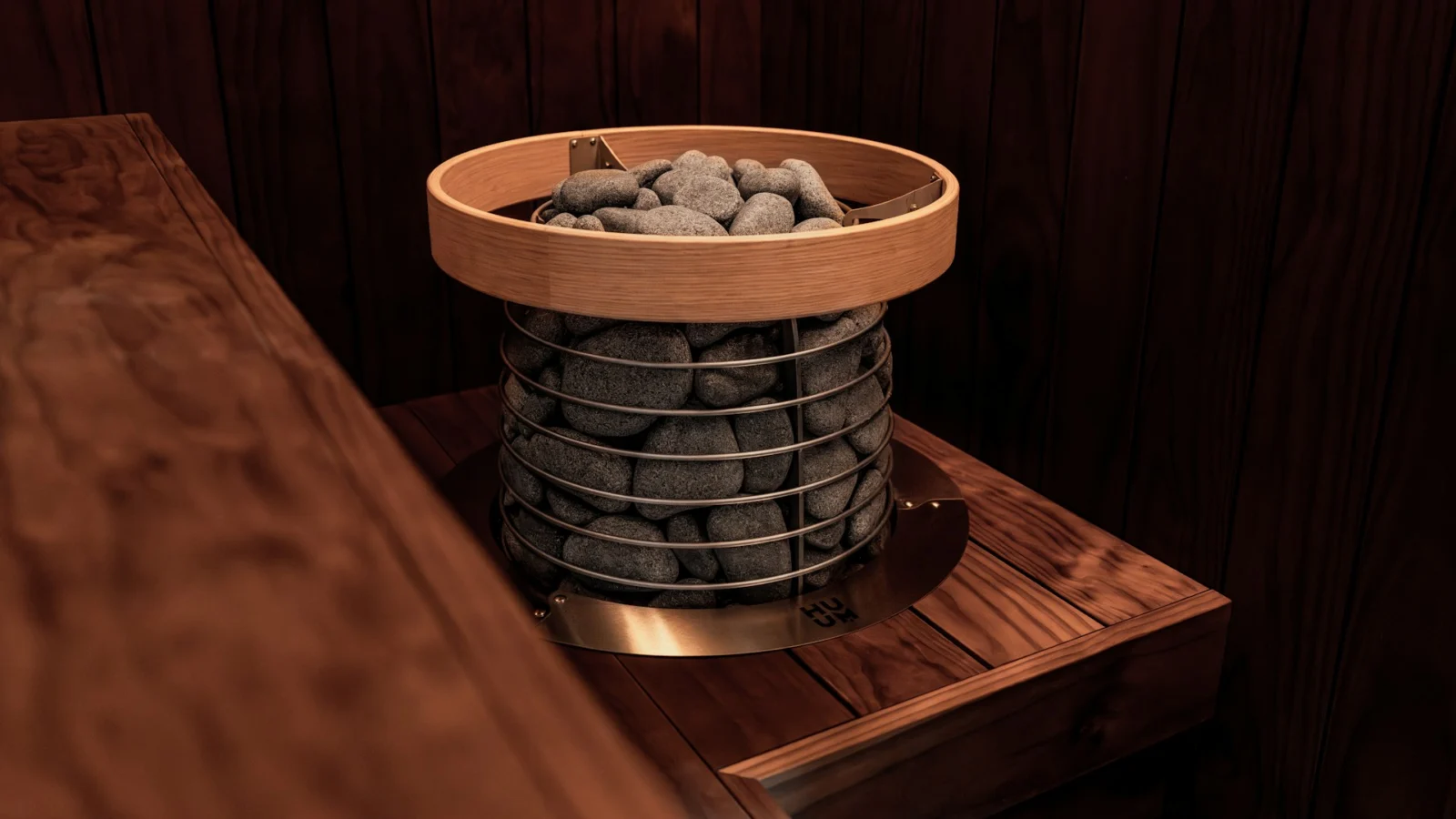
Worth remembering
- Heater size is chosen by room volume in cubic feet or cubic meters, not by floor area.
- Add volume for uninsulated glass, tile, brick or stone before checking a chart.
- HUUM adds 3.3 ft³ per ft² of such wall; Harvia adds 1.2 m³ per m², log walls x1.5.
- Makers' ranges overlap and disagree: a 300 ft³ room fits a 6 kW heater from some brands, not others.
- HUUM says its warranty is void if heater output does not match room volume.
- Wood stoves are rated by room volume too; their kW figures are not comparable to electric heaters.
In this guide
- How to measure sauna volume
- Adding volume for glass, tile, stone and log walls
- Published room ranges for common 240V heaters
- Why the charts disagree, and which one to trust
- When your room sits between two sizes
- 208V supply changes the output
- Wood-burning stoves are sized by volume too
- Stones are part of the heater size
Sauna heater size is chosen by the room’s inside volume. Multiply inside length by width by height, add the maker’s allowance for uninsulated glass, tile, brick or stone, and pick the heater whose published range covers the result. Floor area alone will mislead you, because a 7 foot ceiling and an 8 foot ceiling over the same floor differ by about 14 percent in volume.
For most home saunas the answer is a 240V electric heater between 4.5 and 9 kW. A 4 by 6 foot room with a 7 foot ceiling (168 cubic feet) sits at the small end. A 6 by 7 foot room with a 7 foot ceiling (294 cubic feet) is in 6 to 8 kW territory, depending on the brand. The charts below come from the makers’ own manuals and US product pages, checked in November 2026, and they do not always agree with each other.
How to measure sauna volume
Measure the finished interior, wall paneling to wall paneling and floor to ceiling boards, not the framing. Then do the arithmetic:
- Cubic feet: length (ft) x width (ft) x height (ft). A 5 x 7 x 7 room is 245 cubic feet.
- Cubic meters: length (m) x width (m) x height (m). One cubic meter is 35.3 cubic feet.
- Odd shapes: for a barrel, the makers’ published room volume for that model is more reliable than your own measurement, because the curved walls make a tape-measure estimate rough.
Ceiling height matters more than people expect. HUUM’s US manual recommends a room height of 79 to 91 inches (2,000 to 2,300 mm), with a minimum of 75 inches, so that the volume stays reasonable for the heater. Harvia lists a minimum room height of 6.56 feet (2.0 m) for its KIP heaters. A tall ceiling also puts the hottest air above your head instead of at bench level.
If you want the arithmetic done for you, the sauna heater size calculator takes inside dimensions in feet or meters, adds the glass and tile allowance and lists models whose published range covers the result.
Adding volume for glass, tile, stone and log walls
Insulated wood walls hold heat in. Glass, tile, brick, concrete and stone soak it up, so the heater has to work as if the room were bigger. Each maker states its own allowance:
| Maker and document | Uninsulated glass, tile, brick | Log walls |
|---|---|---|
| HUUM DROP 2.0 manual, US edition (2026) | Add 3.3 ft³ per ft² of such wall (1 m³ per m²) | Not stated |
| Harvia wood-burning stove manuals (M3, Legend) | Add 1.2 m³ per m² of uninsulated wall or ceiling (about 3.9 ft³ per ft²) | Multiply room volume by 1.5 |
| Older HUUM DROP US manual (2021) | Add 53 ft³ (1.5 m³) per m² of such wall | Not stated |
Harvia’s manual gives worked examples: a 10 cubic meter room with a 2 by 2 meter brick wall counts as about 15 cubic meters, a 10 cubic meter room with a glass door as about 12, and a 10 cubic meter room with solid log walls as about 15. Harvia prints that rule in its wood-stove manual. For an electric Harvia heater, confirm the allowance in that model’s own manual or with Harvia support, since the electric manuals checked for this guide do not repeat it.
A worked example in feet: a 6 x 7 x 7 room (294 ft³) with a full-glass door of about 12 ft² gains about 40 ft³ under HUUM’s rule (334 ft³) and about 47 ft³ under Harvia’s (341 ft³). That small change can push the room out of one model’s range and into the next.
The better fix is often to insulate. HUUM’s manual says massive heat-storing surfaces such as glass, concrete and brick in an electric sauna should be insulated so the heater can work at its optimal output, and suggests a 2 to 4 inch (50 to 100 mm) insulation layer with a foil barrier on top. The details are in our guide to sauna vapor barrier and insulation.
Published room ranges for common 240V heaters
These are the room volumes each maker prints for its own heaters at 240V single-phase. They are copied as published, not adjusted.
| Heater | Output | Room volume (ft³) | Room volume (m³) |
|---|---|---|---|
| HUUM DROP 4 | 4.5 kW | 106 to 248 | 3 to 7 |
| HUUM DROP 6 | 6 kW | 177 to 318 | 5 to 9 |
| HUUM DROP 7 | 7.5 kW | 248 to 389 | 7 to 11 |
| HUUM DROP 9 | 9 kW | 283 to 460 | 8 to 13 |
| Harvia KIP60B | 6 kW | 169 to 300 | about 4.8 to 8.5 |
| Harvia KIP80B | 8 kW | 251 to 424 | 7.1 to 12.0 |
| Harvia Virta HL6 | 6 kW | 177 to 294 | 5 to 8 |
| Harvia Virta HL8 | 8 kW | 177 to 431 | 5 to 12 |
| Harvia Virta HL9 | 9 kW | 177 to 494 | 5 to 14 |
| Homecraft Revive Slim | 4 kW | 100 to 150 | not given |
| Homecraft Revive / H-Series | 6 kW | 200 to 325 | not given |
| Homecraft Revive / H-Series | 7.5 kW | 250 to 370 | not given |
| Homecraft Revive / H-Series | 9 kW | 325 to 450 | not given |
| Homecraft Apex | 10 kW | 400 to 625 | not given |
Sources: HUUM DROP 2.0 US manual, Table 2; Harvia’s US pages for the KIP80B and KIP60B; the Harvia Virta owner’s manual for the US market; the Homecraft install manual (Rev A, November 2025). Metric figures for the KIP60B are converted from Harvia’s cubic feet.
Why the charts disagree, and which one to trust
Take a 300 cubic foot room. HUUM puts it in the DROP 6 range (up to 318 ft³) and also the DROP 7 and DROP 9 ranges. Harvia’s KIP60B tops out at exactly 300, while its Virta HL6 stops at 294, so Harvia would steer you to 8 kW in the Virta line. Homecraft’s 6 kW covers it with room to spare (up to 325). Three makers, three answers between 6 and 8 kW.
The differences come from heater design: stone mass, how air moves through the heater, element layout and control. A heater with more stones takes longer to heat but stores more energy for löyly. That is why the only chart that matters is the one for the heater you are buying. Use the others to sanity-check.
Charts also change between editions. HUUM’s 2021 US manual, still circulating on dealer sites, listed the DROP 6 at 177 to 353 cubic feet and the DROP 9 at 282 to 530. The 2026 DROP 2.0 manual narrows those to 177 to 318 and 283 to 460. If a retailer’s listing does not match the manual that ships in the box, follow the manual.
Check product pages for errors too. In November 2026 Harvia’s US page for the Spirit SP90E listed a room volume of 6,251 to 17,445 cubic feet, which is clearly a unit mistake. When a number looks wrong, open the model’s PDF manual.
When your room sits between two sizes
Because the ranges overlap, many rooms fit two heaters. A few points from the manuals help you choose:
- Stay inside a published range. HUUM states that its warranty is not valid if the heater output does not correspond to the calculated room volume. Treat the range as a requirement, not a suggestion.
- Use the adjusted volume, not the raw one. If the glass allowance pushes you past the top of a range, the larger model is the one that matches.
- Check your circuit before you buy up. Going from 6 to 9 kW moves HUUM’s published breaker from 30 to 50 amps and wire from 10 to 8 AWG. See sauna breaker and wire size by heater for each maker’s table.
- Bigger is not free to run. A larger heater draws more power while its elements are on. The math is in how much electricity a sauna uses.
- Outdoor rooms. Some outdoor sauna sellers steer larger rooms away from small heaters; Redwood Outdoors, for example, says it does not offer a 6 kW heater for its larger saunas and advises 8 kW or more. A barrel or cube in a cold yard starts from a lower temperature than an indoor room.
Harvia also reminds owners that heat-up time depends on size, construction and insulation; its Virta manual says a properly insulated room with a correctly sized heater reaches bathing temperature in about an hour.
208V supply changes the output
Many apartment buildings and some homes have 208V service instead of 240V. A heater built for 240V puts out less heat on 208V, and makers publish separate charts for that case. HUUM’s US manual lists the DROP 6 at 4.5 kW on 208V with a room range of 142 to 248 cubic feet, against 6 kW and 177 to 318 cubic feet on 240V. The DROP 9 drops to 6.75 kW and 212 to 354 cubic feet. Homecraft sells three-phase 208V versions with their own ranges, for example 6 kW for 200 to 325 cubic feet. Ask your electrician which supply you have before choosing a model.
Wood-burning stoves are sized by volume too
Wood stoves get a room range from their makers, just like electric heaters, but their kW ratings are not comparable. Harvia rates its M3 wood-burning heater at 16.5 kW and lists it for rooms of 212 to 459 cubic feet (6 to 13 m³), which an electric heater of that output would far exceed. HUUM lists its HIVE Wood 13 for 212 to 459 cubic feet and the HIVE Wood 17 for 283 to 565. The same glass and log-wall allowances apply.
Harvia’s stove manual explains why undersizing hurts: a stove with too little output has to be fired longer and more intensely, which shortens its life. Wood stoves also need a chimney with tested clearances and a fresh-air plan; ventilation for stoves differs from electric heaters, covered in sauna ventilation. Note that the M3’s US product page lists CE and EAC certificates, not a UL listing, so check what your local building department requires for a solid-fuel appliance.
Stones are part of the heater size
The published range assumes the heater is filled with the stones it was designed for. Harvia lists about 44 pounds of stones for the KIP60B and KIP80B and 110 pounds for the Virta. HUUM’s DROP takes about 121 pounds (55 kg). HUUM warns that a sparsely filled stone basket is a fire hazard and that elements must not show through the stones. If a heater seems slow, check the stones before blaming its size; our guide on when to replace sauna stones covers what to look for.
Once you have a model in mind, write down three numbers from its manual before you call an electrician: output in kW, voltage, and the room range you are relying on. The electrician needs the first two, and the third is what your warranty depends on.
Questions people ask
What size sauna heater do I need for a 4x6 sauna?
It depends on the ceiling. A 4 by 6 foot room with a 7 foot ceiling is 168 cubic feet. That is inside HUUM's DROP 4 range (106 to 248 cubic feet, 4.5 kW) and below or right at the minimum of most 6 kW ranges: Harvia's KIP60B starts at 169 cubic feet and HUUM's DROP 6 at 177. Add volume for a glass door before you decide.
Is a bigger sauna heater better?
Not automatically. A heater above the room's range can heat faster but needs a larger breaker and wire, and HUUM states that its warranty does not apply when output does not match the room volume. Harvia warns about the opposite case for wood stoves: one that is too small must be fired longer and harder, which shortens its life. Stay inside the published range for your adjusted volume.
How many kW per cubic meter does a sauna need?
Makers do not use one fixed ratio. Their tables work out to anything from about 0.6 to 1.8 kW per cubic meter depending on the model and where in its range the room falls, and the ranges overlap. Use the chart for the heater you are considering rather than a rule of thumb, then add the maker's allowance for glass, tile and log walls.
Does a glass door change the heater size?
Yes, if it is a large share of the wall. HUUM's US manual adds 3.3 cubic feet of volume for every square foot of uninsulated glass, tile or brick. Harvia's stove manual gives an example where a 10 cubic meter room with a glass door needs the output of about a 12 cubic meter room.
Can I use a 120V sauna heater?
Not for a typical home sauna. The traditional heaters in the makers' tables on this page, from HUUM, Harvia and Homecraft, are 240V units of 4 kW and up that must be hardwired by a licensed electrician. Plug-in 120V home saunas are usually infrared cabins, which heat differently and are sized by the cabin maker rather than by a room-volume chart.
Next round
Keep reading
How Much Does a Home Sauna Cost? 2026 Prices by Type, Plus Installation and Running Costs
As of November 2026, makers' US stores list the smallest home saunas from about $4,000: a one person infrared cabin at $4,200…
Nov 26, 2026 · 7 min read

When to Replace Sauna Stones: Signs, Hours of Use and How Much Stone You Need
Check sauna stones at least once a year, and replace any that crack, crumble or discolor. HUUM's DROP manual is the most…
Nov 26, 2026 · 8 min read
How Hot Should a Sauna Be? Temperatures in °F and °C, Humidity and Heat-Up Times
A traditional sauna is usually set between about 150 and 195 °F (65 to 90 °C). Harvia's US manual calls 149 to…
Nov 26, 2026 · 7 min read