When to Replace Sauna Stones: Signs, Hours of Use and How Much Stone You Need
By the Sauna Advice editors 8 min read Updated November 26, 2026
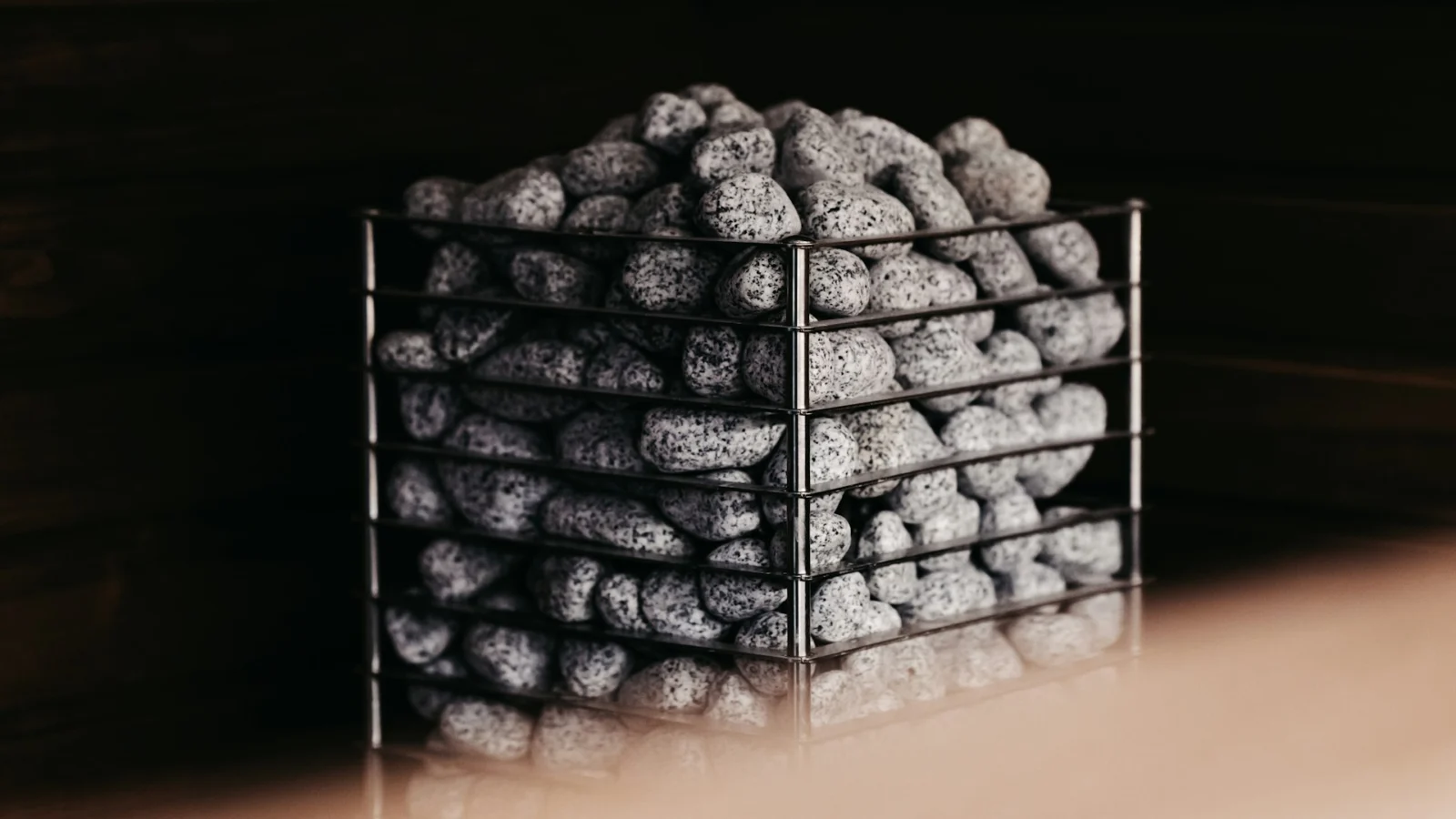
Worth remembering
- Harvia says check stones at least once a year, more often if fragments appear under the heater.
- HUUM: inspect at 100 hours, rearrange at 200 hours, replace all stones at 400 hours.
- Replace stones that crack, crumble when knocked together, or discolor.
- In a Harvia test, tightly packed stones left the room about 10 °C cooler after an hour.
- Harvia's KIP80B takes 44.1 lb (20 kg) of stones; HUUM's DROP takes about 55 kg.
- Use only stones sold for sauna heaters, usually olivine diabase or similar volcanic rock.
- Stones must fully cover the elements; HUUM warns a sparse fill is a fire hazard.
In this guide
Replace sauna stones when they crack, crumble or discolor, and check them at least once a year. The most precise schedule comes from HUUM’s manual for its DROP heater: inspect the stones after 100 hours of use (or at least once a year), rearrange them and replace any cracked ones after 200 hours, and replace all of them after 400 hours. Harvia’s US manual for its KIP heaters is looser, saying that after five years of use the rocks may need replacing if they have crumbled or powdered.
The makers’ figures do not agree, and Redwood Outdoors, a US sauna seller, gives a third, much shorter schedule (table below). The difference is mostly use. A sauna run a few times a month can go years on one fill. One used most evenings will wear through stones in a year or two. Count hours with the heater on, not years.
How long sauna stones last
Stones wear out because they are heated far above room temperature, cooled, and hit with water, over and over. HUUM’s manual puts it plainly: due to large changes in temperature, the heater stones crumble over time, and particles and fine dust are washed onto the floor with the sauna water.
| Source | Inspect | Rearrange | Replace |
|---|---|---|---|
| HUUM DROP manual (2025) | After 100 hours of use, or at least once a year | After 200 hours, replacing any cracked stones | All stones after 400 hours |
| Harvia stone care guide | At least once a year; more often if stone fragments appear under the heater | Restack loosely after washing | Any stone that breaks, crumbles or is discolored |
| Harvia KIP manual (US/Canada) | Not specified | Not specified | After 5 years of usage, if crumbled or powdered |
| Redwood Outdoors care FAQ | Not specified | Every 6 months, heater off at the breaker | Every 12 to 18 months, which it says Harvia recommends |
To turn hours into a calendar, estimate how long the heater runs per session, heat-up included. As an example: three sessions a week with about 90 minutes of heater time each comes to roughly 230 hours a year, so HUUM’s 400-hour full replacement would arrive in under two years. That is our arithmetic from an assumed routine, not a maker figure. Our article on how much electricity a sauna uses walks through typical heat-up times.
Signs your sauna stones need replacing
- Crumbs and grit under the heater. Harvia’s guide names stone residue or small pieces on the floor under the heater as the signal to check the stones more often.
- Cracked or split stones. HUUM says to replace any that have cracked when you rearrange them.
- Stones that crumble when knocked together. Harvia uses this as its test for a worn stone.
- Discoloration. Harvia says discolored stones should be discarded and replaced. Its guide adds that discoloration or limescale on the heater’s elements or frame is a reason to consider replacing the heater and to check it is used as instructed.
- Slower heat-up. As stones break into smaller pieces they settle and pack tightly, which restricts airflow through the heater.
- Elements showing through. If you can see the heating elements between the stones, the fill has settled. HUUM says the elements must not be visible through the stones, and that water ladled directly onto elements shortens their life and gives an excessively sharp heat.
Note what is not on the list: a little dust or a smell on the very first heating. HUUM says both the elements and new stones give off odors when the heater is first switched on and that the room should be well ventilated; that passes.
What worn stones do to the heater
Harvia tested it. In a 10 cubic meter (about 350 cubic foot) sauna with a Harvia Cilindro PC70E 7 kW heater, the room reached about 70 °C (158 °F) after one hour with new stones laid loosely, and only about 60 °C (140 °F) with new stones stacked tightly. Heating element temperatures rose as the stones got worse: a peak of 580 °C with new loose stones, 640 °C with old loose stones and 680 °C with old, tightly packed stones.
Hotter elements wear faster. Harvia’s guide warns that grit from broken stones can damage the heater, and Redwood Outdoors says settling stones can push the coils into contact with each other, which burns them out quickly. Harvia’s US manual makes a related point in its troubleshooting section: if a room does not come up to temperature, check that stones are loosely spaced around the elements, because stones packed too tightly restrict air flow and reduce heating capacity. A new box of stones costs far less than a set of elements.
Rearranging vs replacing
Not every check ends with new stones. Harvia’s guide says to tap stones together, discard any that crumble or are discolored, and wash and dry the rest before restacking. A rearrange looks like this:
- Turn the heater off at the breaker and let it cool to room temperature. Harvia’s US manual says to turn power off at the breaker before servicing the heater. Anything beyond the stones, such as elements or wiring, is work for a licensed electrician or service technician, following the heater’s manual and local code.
- Wear gloves. Lift the stones out one at a time.
- Vacuum grit from inside the stone space and from the floor under the heater.
- Sort the stones. Discard any that are cracked, crumbly or discolored, plus small fragments.
- Wash the keepers and let them dry, as Harvia recommends.
- Restack loosely, adding new stones to replace the discards.
Here the makers disagree on order. HUUM says to start with bigger stones at the bottom and sides and use smaller stones to fix them in place, laying them one by one, never pouring or throwing them in. Harvia’s US KIP manual says the opposite for that heater: use smaller stones first and continue with larger stones until they are about 2 inches (50 mm) below the rock guard. Follow the manual for your specific heater, since the stone space differs between models.
They also differ on density. Harvia’s US manual says stones should be placed loosely so air circulates around and through them, and its test above shows what tight packing costs. HUUM asks you to try to lay the stones tightly while leaving some room for air, and to lay the outer surface tightly so no element shows. Both agree that the elements must be completely covered and that stones must never be forced between elements, which can bend or damage them. In practice: snug enough that nothing shows or wobbles, never jammed.
How much stone each heater takes
| Heater | Type | Stone amount | Stone size |
|---|---|---|---|
| Harvia KIP80B (US, 8 kW, 240V) | Electric, wall | 44.1 lb (about 20 kg) | 2 to 4 in (5 to 10 cm) |
| HUUM DROP (EU manual) | Electric, wall | About 55 kg (about 121 lb) | 5 to 10 cm (2 to 4 in) |
HUUM’s manual adds that the DROP weighs 65 kg in total with stones, so the wall has to carry it. Large floor-standing heaters and wood stoves take considerably more stone; the number is in each model’s spec sheet or manual. For sizing the heater itself, see our sauna heater size guide.
Stones are sold by weight. As of November 2026, Almost Heaven’s store listed its 40 lb box of olivine diabase at $135 to $143 regular (standard or large size) and its 40 lb vulcanite box from $163, with rounded and decorative stones in 22 and 33 lb boxes at about $168, before holiday discounts. As of 2026, a full replacement for a typical home wall heater takes one to three boxes, depending on the model; buy a little more than the manual’s figure so you can discard the small pieces.
Which stones to use
Use stones sold specifically for sauna heaters, and check that your heater’s maker approves them. The common types:
- Olivine diabase. The standard. Harvia sells olivine diabase and says its stones are tested by the Geological Survey of Finland. Almost Heaven’s standard stones are olivine diabase from Finland’s Satakunta region.
- Olivine. HUUM names olivine diabase and olivine, sold specifically for sauna heaters, as suitable natural stones.
- Vulcanite. A black volcanic stone offered by Harvia and Almost Heaven, often used on the top layer.
- Rounded stones. Tumbled versions of the same rock. Some heaters require them: Harvia’s guide says its Spirit heater needs round stones.
- Heat-treated heavy-duty stones. Harvia says commercial heaters need specially heat-treated stones that last longer under heavy use.
Avoid decorative stones, river rocks, landscaping rock and anything of unknown origin in the main fill. HUUM says decorative stones do not accumulate enough heat and break easily, that broken pieces can block air holes and damage elements, and that damage from unsuitable stones is not covered by warranty. Harvia’s US manual says to use only stones purchased from an official Harvia distributor. Decorative or ceramic stones belong only where the heater’s manual allows them, usually as a loose top layer.
Water, overfilling and underfilling
The water you throw affects the stones and the heater. Harvia’s US manual says to use only clean tap water, never pool, spa or well water, because chlorine gas can be produced and the elements can be damaged. HUUM notes that iron-rich water can stain light tile grout under the heater. Ladle small amounts; our sauna etiquette guide covers how löyly is thrown, and how hot a sauna should be covers when the stones are ready.
Fill level affects safety as well as performance. HUUM’s manual warns in capitals that a too sparsely filled stone container causes a fire hazard, because exposed elements radiate extra heat toward nearby surfaces and the published safety distances no longer apply. Harvia’s guide warns the other way: overloading the heater with too many stones can prevent good airflow. The right fill covers every element, sits loosely, and stops where your manual says to stop.
Questions people ask
How often should you replace sauna stones?
It depends on hours of use and on whose advice you follow. HUUM's DROP manual says to inspect after 100 hours or at least yearly, rearrange and replace cracked stones after 200 hours, and replace all stones after 400 hours. Harvia says to check at least once a year and replace stones that crumble or discolor. Redwood Outdoors, a US seller, says to restack every 6 months and replace every 12 to 18 months.
How long do sauna rocks last?
There is no single lifespan. Stones break down from repeated heating and cooling and from water thrown on them. HUUM sets a full replacement at 400 hours of use. Harvia's US KIP manual says that after five years of use the rocks may need replacing if they have crumbled or powdered, which fits lighter use. Check them yearly either way.
Do you need to replace sauna rocks?
Yes, eventually. Harvia warns that broken stones can shift into cavities and block airflow, and that grit from broken stones can damage the heater. Its own test found tightly packed stones made the room about 10 °C cooler after an hour of heating. Replacing worn stones is cheap compared with new elements.
Can you use any rocks in a sauna heater?
No. Use only stones sold for sauna heaters and approved by your heater's maker. HUUM says natural stones such as olivine diabase or olivine are suitable and that decorative stones do not store enough heat and break easily, with damage from unsuitable stones excluded from the warranty. Harvia's US manual says to use stones bought from an official Harvia distributor.
How many stones does a sauna heater need?
It varies a lot by model, so read the manual. Harvia lists 44.1 lb (20 kg) of stones for its KIP80B 8 kW wall heater, and HUUM's manual says its DROP heater takes about 55 kg. Large heaters and wood stoves hold more. Buy enough to cover the elements completely with stones placed loosely, plus a few spares.
Should sauna stones be washed?
Yes, before they go into the heater. Harvia says to wash the stones and let them dry before restacking, and both Harvia's US manual and HUUM's manual say to rinse new stones under running water to remove dust. Dust left on the stones burns off and smells on the first heating, and fine stone dust can darken walls over time.
Next round
Keep reading
How Much Does a Home Sauna Cost? 2026 Prices by Type, Plus Installation and Running Costs
As of November 2026, makers' US stores list the smallest home saunas from about $4,000: a one person infrared cabin at $4,200…
Nov 26, 2026 · 7 min read
Sauna Heater Size: How Many kW for Your Room, With Makers’ Own Charts
Size an electric sauna heater from the room's inside volume: length times width times height. Add an allowance for uninsulated glass, tile…
Nov 26, 2026 · 8 min read
How Hot Should a Sauna Be? Temperatures in °F and °C, Humidity and Heat-Up Times
A traditional sauna is usually set between about 150 and 195 °F (65 to 90 °C). Harvia's US manual calls 149 to…
Nov 26, 2026 · 7 min read