How Much Electricity Does a Sauna Use? kWh and Cost per Session, Month and Year
By the Sauna Advice editors 7 min read Updated November 26, 2026
Worth remembering
- Heater kW equals kWh per hour at full power: 6 kW uses up to 6 kWh an hour.
- Makers quote about one hour to heat an insulated room to bathing temperature.
- A 6 kW session with heat-up and an hour of use is about 9 to 12 kWh.
- At the US average of 18.17 cents per kWh, that is about $1.60 to $2.20 per session.
- State rates range from about 13 cents (Nevada, Louisiana) to over 48 cents (Hawaii) per kWh.
- A 2,260 W infrared cabin uses about 2.3 kWh for an hour, around 41 cents at the US average.
In this guide
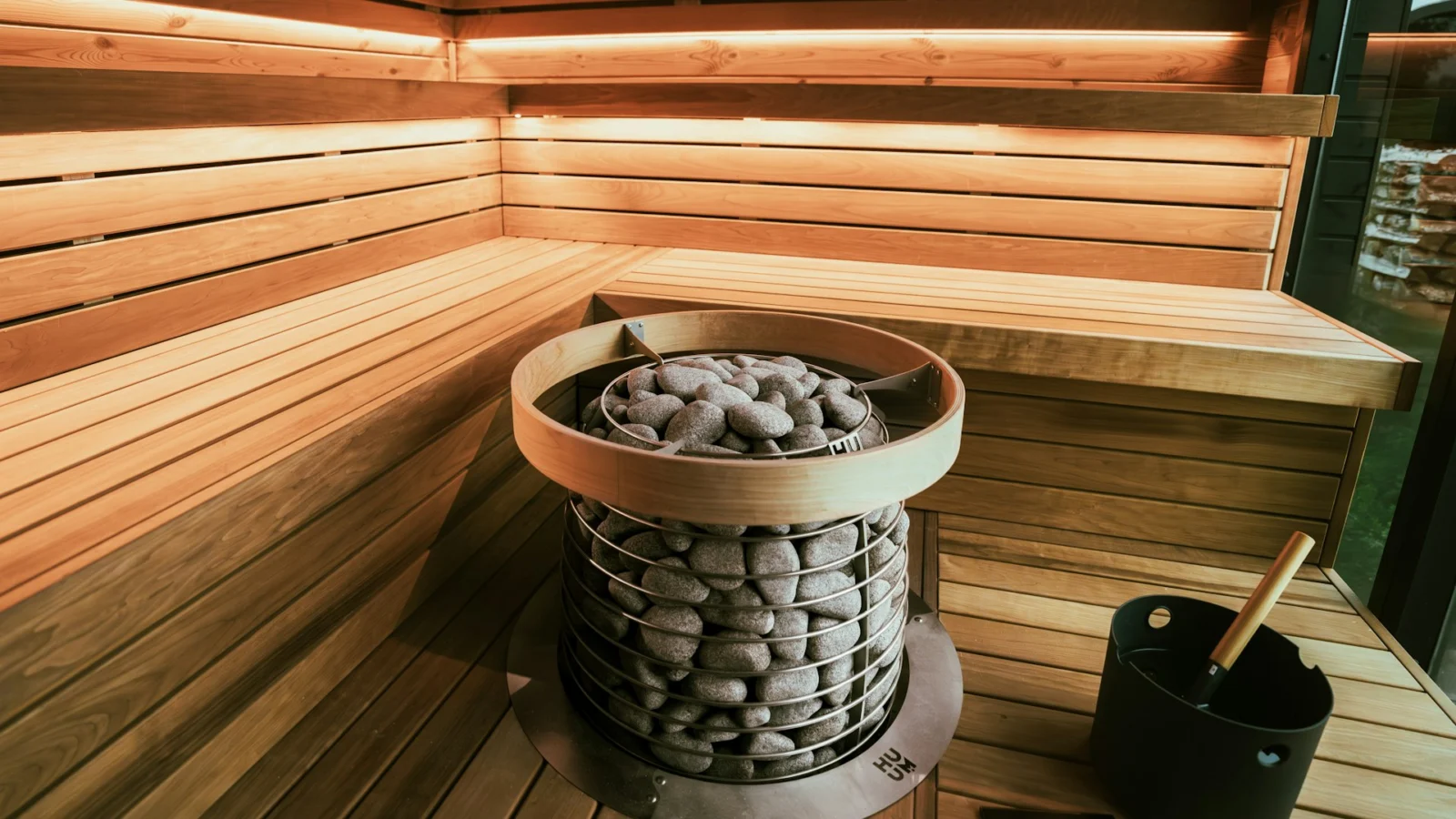
A traditional electric sauna uses up to its heater’s rating in kilowatt-hours for every hour the elements are on. A 6 kW heater draws at most 6 kWh per hour, a 9 kW heater 9 kWh. Add the hour that makers say a well-insulated room needs to reach bathing temperature, plus an hour of use, and a 6 kW sauna uses about 9 to 12 kWh per session. At the US average residential rate of 18.17 cents per kWh, that is roughly $1.60 to $2.20.
Infrared cabins use much less. Clearlight rates its two person Sanctuary 2 at 2,260 watts, so an hour of preheat and use is about 2.3 kWh, around 41 cents at the same average rate. The rest of this page shows the math, the state-by-state rates and what pushes your number up or down.
The formula: kW x hours x your rate
Electric sauna heaters are resistive loads, so their energy use is simple:
- Energy (kWh) = heater kW x hours the elements are on.
- Cost = kWh x your price per kWh, from your bill or the state average.
The catch is “hours the elements are on”. During heat-up the elements run continuously until the room reaches the thermostat setting. After that the thermostat cycles them on and off to hold the temperature. Makers do not publish how much of the session the elements stay on, because it depends on insulation, ventilation, how often the door opens and how much water you throw on the stones. So the honest way to estimate is a range:
- Upper bound: elements on for the whole heat-up and the whole session.
- Illustration: elements on for the whole heat-up and half of the session. This 50 percent figure is an assumption for comparison, not a measured or published value.
How long the heater runs before you get in
Heat-up time is the biggest single part of a traditional sauna’s energy use. The makers’ figures:
- HUUM’s US manual: in a properly insulated room with a heater of the right capacity, it takes around one hour to reach the desired temperature.
- Harvia’s Virta manual: about an hour for a properly insulated sauna to reach bathing temperature, if the heater output suits the room.
- Redwood Outdoors, for its outdoor saunas with electric heaters: about 30 minutes to 160 °F and under an hour to 190 °F, longer in cold weather.
- Clearlight, for infrared cabins: preheat 10 to 15 minutes.
A heater that is too small for the room runs longer and may never reach the temperature you want, which costs more per session than the right size. Our guide to sauna heater size explains how to match the heater to the room.
kWh and cost per session by heater size
These figures assume one hour of heat-up and one hour of bathing, priced at the EIA’s September 2026 US average residential rate of 18.17 cents per kWh. “Half on” assumes the elements run half the bathing hour, as explained above.
| Heater | kWh, upper bound | kWh, half on | Cost per session (US average) | Per month, 3 sessions a week |
|---|---|---|---|---|
| 4.5 kW | 9.0 | 6.75 | $1.23 to $1.64 | $16 to $21 |
| 6 kW | 12.0 | 9.0 | $1.64 to $2.18 | $21 to $28 |
| 8 kW | 16.0 | 12.0 | $2.18 to $2.91 | $28 to $38 |
| 9 kW | 18.0 | 13.5 | $2.45 to $3.27 | $32 to $43 |
| Infrared, 2,260 W, 1 hour total | 2.26 | n/a | about $0.41 | about $5 |
Three sessions a week is about 13 sessions a month. For a year, multiply the monthly figure by 12: a 6 kW sauna used three times a week comes to roughly $255 to $340 a year at the US average.
A bigger heater does not always cost more per session in practice. If it is correctly sized for a bigger room, it heats that room in about the same hour. The table compares heaters at equal run time, which is a fair upper bound but not a prediction for your room.
What a session costs in your state
Electricity prices vary more than heater sizes do. The EIA’s Electric Power Monthly, Table 5.6.A, released November 24, 2026, gives average residential prices for September 2026; the EIA marks 2026 values as preliminary. Here is a 6 kW sauna (9 to 12 kWh per session) at a selection of state averages:
| State | Residential rate, Sep 2026 | 6 kW session | Per month, 3 a week (half on) | Infrared 2,260 W, per month |
|---|---|---|---|---|
| Hawaii | 48.31 ¢/kWh | $4.35 to $5.80 | $57 | $14 |
| Massachusetts | 30.97 ¢ | $2.79 to $3.72 | $36 | $9 |
| California | 30.86 ¢ | $2.78 to $3.70 | $36 | $9 |
| New York | 28.42 ¢ | $2.56 to $3.41 | $33 | $8 |
| Michigan | 23.17 ¢ | $2.09 to $2.78 | $27 | $7 |
| Pennsylvania | 22.20 ¢ | $2.00 to $2.66 | $26 | $7 |
| Illinois | 19.14 ¢ | $1.72 to $2.30 | $22 | $6 |
| US average | 18.17 ¢ | $1.64 to $2.18 | $21 | $5 |
| Minnesota | 17.37 ¢ | $1.56 to $2.08 | $20 | $5 |
| Texas | 15.91 ¢ | $1.43 to $1.91 | $19 | $5 |
| Washington | 15.00 ¢ | $1.35 to $1.80 | $18 | $4 |
| Florida | 14.74 ¢ | $1.33 to $1.77 | $17 | $4 |
| Louisiana | 13.33 ¢ | $1.20 to $1.60 | $16 | $4 |
| Nevada (lowest) | 13.25 ¢ | $1.19 to $1.59 | $16 | $4 |
State averages blend every utility and rate plan. Your own bill is the better number, especially on a time-of-use plan, where an evening sauna can land in the most expensive hours. If your utility charges less overnight or on weekends, heating the sauna in those windows changes the cost more than any heater choice.
Infrared sauna electricity use
Infrared cabins heat with panels rated in watts, typically far below a traditional heater. Clearlight lists the Sanctuary 2 at 120V, 2,260 watts and 18.83 amps. Its larger cabins run on 240V circuits of 15 to 30 amps.
Clearlight’s FAQ puts its operating cost at about 20 to 25 cents per session. That is lower than the 41 cents that 2,260 watts for a full hour would cost at the US average rate. The difference likely comes from a shorter session or a cheaper electricity rate, and Clearlight does not state its assumptions, so use the wattage and your own rate for a firm number. Clearlight also tells owners to set the thermostat to its maximum so the heaters stay on for the whole session, which makes the full-wattage estimate realistic for a Clearlight session.
The lower running cost is one reason people pick infrared. The other differences, from temperature to steam, are in infrared sauna vs traditional saunas.
What raises or lowers the number
- Outdoor saunas in winter. A barrel or cube in a cold yard starts far below room temperature and loses heat through its walls faster. Redwood Outdoors says a sauna starting at 20 °F takes longer to heat, and that in colder months preheating may need more than 60 minutes. Each extra half hour at full power on a 6 kW heater adds 3 kWh. Shapes compared in barrel sauna vs cube sauna.
- Glass and masonry. Glass walls, tile and stone absorb heat. HUUM’s US manual and Harvia’s Legend stove manual both add room volume for these surfaces when sizing a heater, and the same surfaces keep the elements on longer during the session.
- Insulation. HUUM’s manual says heat-storing surfaces in an electric sauna should be insulated so the heater can work at its regular output. A well-built wall with a foil vapor barrier is the cheapest energy saving there is; see sauna vapor barrier and insulation.
- Thermostat setting. A hotter setting means a longer heat-up and more cycling. Many owners find the room usable before it reaches the top setting.
- Door openings and ventilation. Every time the door opens, hot air escapes and the heater has to make it up. Ventilation is still required; makers specify it for air quality and to protect the wood.
- Leaving it on. Heaters with timers and automatic shut-off limit runaway use. A heater left running for an extra hour at 6 kW costs about $1.09 at the US average.
How to measure your own sauna’s use
Every number above is an estimate built from the heater rating and the makers’ heat-up times. Your own sauna can tell you the real figure, and it takes one evening:
- Check your utility’s usage data. Many utilities with smart meters show hourly or 15-minute consumption in their app or online account. Compare an evening with a sauna session against a similar evening without one; the difference is your sauna.
- Read the meter. If you have no hourly data, note the meter reading right before you switch the heater on and again when you switch it off, with other big loads such as a dryer or EV charger idle.
- Note the conditions. Write down the outdoor temperature, how long the room took to heat and how long you used it. A cold January session and a mild September one can differ a lot for an outdoor sauna.
- Price it with your own rate. Use the per-kWh total from your bill, including delivery charges, rather than the supply rate alone.
Two or three measured sessions give you a better monthly estimate than any table, and they show quickly whether a lower thermostat setting or a shorter preheat changes anything.
Checking the circuit as well as the bill
Energy cost is one side of a heater’s electrical demand; the circuit it needs is the other. A 6 kW heater draws 25 amps at 240V and a 9 kW heater 37.5 amps, and makers publish breaker sizes from 30 to 50 amps for them. A licensed electrician sizes and installs that circuit to the heater’s manual and local code. The makers’ tables are in sauna breaker and wire size, and the sauna heater size calculator shows which heaters fit your room so you can compare their kW before buying.
For a quick estimate of your own cost, take the heater’s kW, multiply by 1.5 to 2 hours, then by the price per kWh on your last bill. That one line gets you within the range of everything above.
Questions people ask
How much electricity does a sauna use per hour?
At most its heater rating. A 4.5 kW heater uses up to 4.5 kWh per hour, a 6 kW heater 6 kWh and a 9 kW heater 9 kWh. Once the room reaches the set temperature the thermostat switches the elements on and off, so actual use during bathing is lower. Infrared cabins use their rated wattage: Clearlight's two person Sanctuary 2, for example, is rated at 2,260 watts, or about 2.3 kWh per hour.
How much does it cost to run a sauna per month?
It depends on heater size, how often you use it and your rate. A 6 kW sauna used three times a week, at 9 to 12 kWh per session, comes to about $21 to $28 a month at the September 2026 US average of 18.17 cents per kWh. The same use costs roughly $18 to $23 in Washington and $57 to $75 in Hawaii.
Does an infrared sauna use less electricity than a traditional sauna?
Yes, per session. Clearlight's two person Sanctuary 2 is rated at 2,260 watts and heats in 10 to 15 minutes, so an hour of use is about 2.3 kWh. A 6 kW traditional heater needs about an hour of heat-up alone. The trade-off is that infrared cabins run far cooler and have no steam.
Is it expensive to run an outdoor sauna in winter?
It costs more than in summer because the room starts colder and loses heat faster. Redwood Outdoors notes that a sauna starting at 20 °F takes longer to heat and that in colder months preheating may need more than 60 minutes. Every extra half hour at full power on a 6 kW heater adds about 3 kWh, about 55 cents at the US average rate.
Does a wood-burning sauna use electricity?
Only for lights and any fan or controller. The stove itself burns wood, so the running cost is firewood rather than kilowatt-hours, and that depends on the stove, the wood and how long you keep the fire going. Electric lighting in a sauna is a small load compared with any electric heater, which is why off-grid cabins often choose wood.
Next round
Keep reading
How Much Does a Home Sauna Cost? 2026 Prices by Type, Plus Installation and Running Costs
As of November 2026, makers' US stores list the smallest home saunas from about $4,000: a one person infrared cabin at $4,200…
Nov 26, 2026 · 7 min read
How Hot Should a Sauna Be? Temperatures in °F and °C, Humidity and Heat-Up Times
A traditional sauna is usually set between about 150 and 195 °F (65 to 90 °C). Harvia's US manual calls 149 to…
Nov 26, 2026 · 7 min read
Sauna Breaker and Wire Size for 4.5, 6, 8 and 9 kW Heaters, From the Manuals
Makers publish breaker and wire sizes, and they differ. At 240V, HUUM lists 30 amps and 10 AWG for 4.5 and 6…
Nov 26, 2026 · 8 min read