Barrel Sauna vs Cube Sauna: Volume, Headroom, Benches, Roof and Price
By the Sauna Advice editors 7 min read Updated November 26, 2026
Worth remembering
- Almost Heaven's 6 x 6 ft Pinnacle barrel works out to about 163 cubic feet inside.
- Its Blackwater cube is about 232 cubic feet, with a 9 kW electric or wood stove option.
- Barrels seat people on two facing benches; cubes and cabins add a higher upper bench.
- Regular prices as of November 2026: Redwood barrel $6,299, Redwood cabin $7,299, both with 6 kW heaters.
- Both shapes need a level base that carries 1,000 lb or more, such as pavers or a slab.
- Barrel tops can seep in hard rain; makers sell roof covers or shingle kits.
- The 240V heater circuit must be sized and installed by a licensed electrician.
In this guide
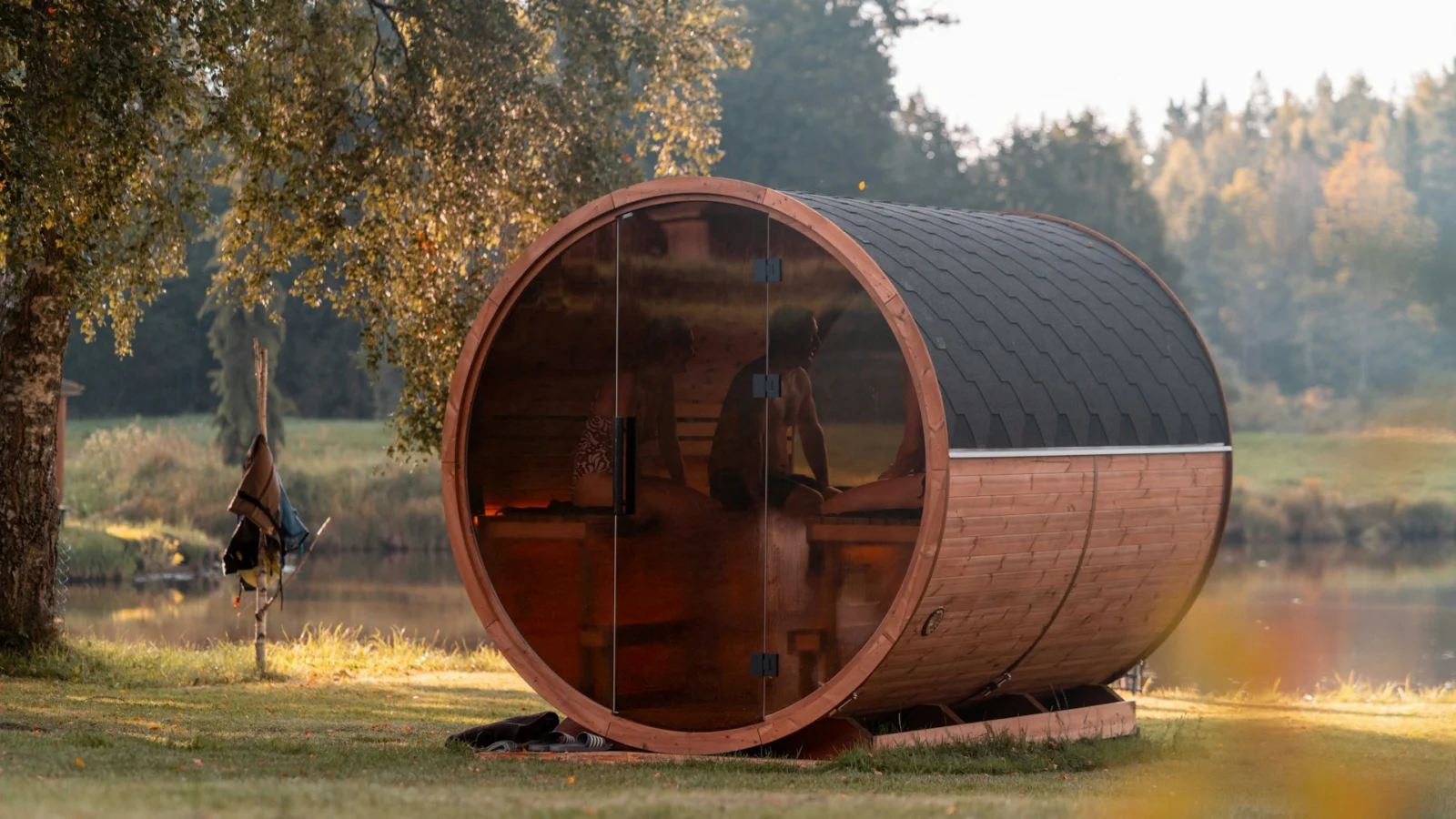
A barrel sauna is the cheaper and simpler outdoor sauna: a tube of wooden staves held by steel bands, with two facing benches and less air to heat for its footprint. A cube sauna (sold as cube, square or cabin sauna) costs more, gives full headroom from wall to wall and lets you put a high upper bench up where the heat collects. The two shapes in most US kits share the same wall: 1 3/8 to 1 1/2 inch solid wood staves with no insulation.
So the real choice is about space and seating, not about which shape is “hotter.” Below are the numbers from two US makers that sell both shapes, Almost Heaven Saunas (part of the Harvia Group) and Redwood Outdoors, checked on their own sites in November 2026.
Barrel vs cube at a glance
| Model (maker) | Shape | Interior W x D x H | Interior volume | Heater included | Regular price, as of Nov 2026 |
|---|---|---|---|---|---|
| Pinnacle 4 person (Almost Heaven) | Barrel, 6 x 6 ft | 75 1/4 x 63 1/4 x 69 1/4 in | about 163 ft³ (our calculation) | 6 kW Harvia KIP, 240V 30 A | $7,575 to $11,774, by door, window and heater |
| Blackwater 4 person (Almost Heaven) | Cube | 79 5/8 x 63 1/4 x 79 5/8 in | about 232 ft³ (our calculation) | 9 kW heater or M3 wood stove, 240V 45 A for electric | $14,085 to $15,399, by finish |
| Barrel 6 person (Redwood Outdoors) | Barrel | 69 1/4 x 64 1/8 x 67 3/4 in | 140 ft³ (listed) | 6 kW Harvia KIP | $6,299 |
| Cabin 4 person (Redwood Outdoors) | Cabin (square, pitched roof) | 56 x 67 x 78 1/8 in | 169.6 ft³ (listed) | 6 kW Harvia KIP | $7,299 |
Almost Heaven does not list interior volume, so the two Almost Heaven figures are our arithmetic from its interior dimensions: the barrel as a cylinder, the cube as a box, benches not subtracted. The same cylinder method reproduces Redwood’s own 140 cubic feet for its barrel exactly, so the numbers compare fairly. Both makers were running holiday sales when checked on November 26, 2026: Almost Heaven showed 30% off (Pinnacle from about $5,300, Blackwater from about $9,860) and Redwood $1,000 off both models. Prices change often; the maker’s page is the current figure. For what the rest of the project costs, see how much a home sauna costs.
Interior volume and heat-up
Barrel makers describe the round shape as circulating heat along the walls. That may well be true, but none of the makers checked publishes a measured heat-up comparison between its barrels and cubes. What you can compare is how much air each kilowatt has to heat:
- Pinnacle barrel: about 163 ft³ on 6 kW, roughly 27 ft³ per kW.
- Blackwater cube: about 232 ft³ on 9 kW, roughly 26 ft³ per kW.
- Redwood barrel: 140 ft³ on 6 kW, about 23 ft³ per kW.
- Redwood cabin: 169.6 ft³ on 6 kW, about 28 ft³ per kW.
Those ratios are close, which suggests the makers size their heaters to give similar performance across shapes. They are also generous compared with indoor rooms. Harvia’s own table for the 6 kW KIP lists a room of 170 to 300 cubic feet, yet both 6 kW barrels here are smaller than that. Solid, uninsulated wood walls lose more heat than an insulated indoor room, and HUUM’s architect counts log walls among the surfaces that add to the volume a heater must cover. Our heater sizing guide and sauna heater size calculator explain the allowance.
In practice, outdoor temperature and wind change heat-up time more than shape does. A January evening in Minnesota and a mild night in Georgia are not the same sauna, whichever shape you buy.
Headroom and bench layout
This is where the shapes differ most. A barrel is only full height along its center line. Almost Heaven’s Pinnacle is 69 1/4 inches tall inside at the peak, and the walls curve down toward the benches. Redwood lists 4 feet 1 1/8 inches of headroom above the bench in its 6-person barrel, enough to sit upright but not to stand straight near the walls.
The benches are two facing rows at the same height, each 16 inches wide and 63 1/4 inches long in the Pinnacle. Everyone sits at the same temperature, and you can lie down along a bench if you have it to yourself.
A cube or cabin uses the full height. Almost Heaven’s Blackwater is 79 5/8 inches tall inside with a 24 inch upper bench and a 20 inch lower bench. Redwood’s 4-person cabin is 6 feet 6 1/8 inches tall inside, with an upper bench 23 5/8 inches deep and 3 feet 11 1/4 inches of headroom above it. That headroom is slightly less than in the barrel, because the upper bench is raised into the hot zone on purpose.
That raised bench is the cube’s main advantage. Heat stratifies: Harvia’s KIP manual gives an example where 180 °F above the heater corresponds to about 140 °F at the upper bench and 120 °F at the lower bench. Two bench levels let people choose their heat without touching the thermostat. Our guide to how hot a sauna should be covers target temperatures.
Roof, rain and snow
A barrel needs no separate roof. Its top staves are the roof. The tradeoff is water. Almost Heaven’s barrel manual says water may seep in at the top and sides because of the porous softwood and the tongue-and-groove joints, that it will not harm the sauna and usually evaporates quickly in the hot interior. For a fully dry sauna it suggests a shelter with a roof over the barrel or its rain jacket cover, listed from $337 at regular price on its site as of November 2026. Redwood includes asphalt shingles with its barrel and says some seepage on a rainy day will not harm the sauna.
Cubes and cabins come with a roof covering: Almost Heaven’s Blackwater kit includes three panels of metal roofing with trim, and Redwood’s cabin includes asphalt roll roofing and underlay, with a metal roof kit as an upgrade. Keep that covering in good repair, because on a stave-built cube it is the only weather layer over the top staves.
Wood movement, bands and upkeep
Stave-built saunas move with the seasons. Almost Heaven’s manual says the wood swells into the bands when wet and shrinks when dry, that you may eventually need to add filler staves (extras are supplied), and that you should check band tension every few months, especially in the first months of ownership. Its cube uses the same stave-and-band construction, with three bands.
Exterior finish is optional. Almost Heaven says the lumber can be left to weather or treated with a UV-inhibiting exterior stain, never painted or varnished, and the interior never treated unless the product is approved for saunas. Redwood says treating the exterior of its heat-treated hemlock is optional: untreated wood stays durable but turns silver-gray in the sun, and standard stains or sealants never go inside. For interior wood care, see our sauna wood guide.
Foundation and siting
Both shapes sit on wooden cradles and need a firm, level base. Almost Heaven tells buyers to plan for the weight of the sauna and its users at 1,000 pounds or more, and if the sauna sits on the ground, to set the cradles on paver stones so they do not settle. Redwood lists its 6-person barrel at 900 pounds and its 4-person cabin at 1,150 pounds before people, and recommends a concrete pad or footings under each cradle, a solid deck or reinforced platform, compacted gravel or a level stone or paver patio.
Level matters more than material. Almost Heaven warns that a pronounced slope causes poor-fitting staves and needs shimming, and that in very windy sites you should make sure the door cannot blow open. Check setbacks and whether your town treats a sauna as an accessory structure needing a permit before you pour anything.
Wiring an outdoor barrel or cube
The electric versions in this comparison all use hardwired 240V heaters: Almost Heaven lists a 30 amp requirement for the Pinnacle’s 6 kW heater and 45 amp for the Blackwater’s 9 kW, plus a separate 120V, 15 amp plug-in connection for the light. Redwood lists 30 A for 6 kW and 40 A for 8 kW. Almost Heaven’s manual says electrician costs vary with the distance from your panel and recommends getting quotes from two or three licensed electricians.
Those figures are the makers’ published requirements, not a design for your yard. A licensed electrician must size and install the circuit, including the run to the sauna and any subpanel, and the heater’s installation manual and local code take precedence over anything listed on a product page. Our sauna breaker and wire size guide shows what heater makers publish for each kW.
Which one to choose
- Choose a barrel if budget comes first, two or three people usually use it at once, you like lying down on a bench, and you want the classic look with no roof to maintain.
- Choose a cube or cabin if you want to stand up inside, want a high bench for a hotter seat and a lower one for guests, plan to use a wood stove with room for clearances, or want large windows.
- Consider a framed, insulated cabin if you will use it hard through a northern winter. Neither stave-built shape has insulation; a framed outdoor sauna built with the layers in our vapor barrier and insulation guide holds heat better, at a higher build cost.
Before ordering either, measure the delivery path. Both makers ship kits crated: Redwood’s 6-person barrel crate is listed at 3 feet 10 inches wide and 7 feet 11 inches long, and it has to reach the spot where you will assemble it.
Questions people ask
Is a barrel sauna better than a cube sauna?
Neither is better in general. A barrel costs less for the same capacity and has less air to heat, and its top staves double as the roof. A cube or cabin gives you standing headroom, a higher upper bench and corners for a heater and benches, but it costs more and needs a roof covering. Pick by how many people sit at once and whether you want two bench levels.
Do barrel saunas heat faster than square saunas?
Barrel makers say the curved walls circulate heat well, but none of the makers checked here publishes a measured heat-up comparison. What you can compare is air volume per kilowatt. Almost Heaven's Pinnacle barrel has about 27 cubic feet per kW of heater and its Blackwater cube about 26, so on paper they heat at similar rates. Heat-up also depends on outdoor temperature and wind.
How big is a 4 person barrel sauna inside?
Almost Heaven lists the interior of its 4-person Pinnacle barrel as 75 1/4 inches wide, 63 1/4 inches deep and 69 1/4 inches high, with two 16 inch wide benches 63 1/4 inches long. That is about 163 cubic feet if you calculate it as a cylinder. Redwood Outdoors lists its 6-person barrel at 140 cubic feet with 4 feet 1 inch of headroom above the bench.
Do barrel saunas leak?
They can seep. Almost Heaven's barrel manual says water may seep in at the top and sides because of the porous softwood and the tongue-and-groove staves, that it will not harm the sauna and usually evaporates in the heat, and that bands must be kept snug. For a fully dry interior it suggests a shelter with a roof, or its own rain jacket cover for the top.
What foundation does a barrel or cube sauna need?
A firm, level base that carries the sauna plus its users. Almost Heaven says plan for 1,000 pounds or more and, if the sauna sits on the ground, set the cradles on paver stones so they do not sink. Redwood Outdoors lists a concrete pad or footings, a solid deck, compacted gravel or a level paver patio. A pronounced slope needs shimming or leveling first.
How much does a barrel sauna cost compared with a cube?
As of November 2026, Redwood Outdoors listed its 6-person barrel at $6,299 regular price and its 4-person cabin at $7,299, both with a 6 kW heater. Almost Heaven listed its Pinnacle barrel at $7,575 to $11,774 and its Blackwater cube at $14,085 to $15,399 regular, depending on options, with 30 percent holiday discounts running. Electrician, foundation and delivery are extra.
Next round
Keep reading
Best Wood for a Sauna: Walls, Benches, Floor and What to Avoid
The best wood for a sauna is a clear, kiln-dried, low-resin softwood or light hardwood, left unfinished. Harvia's US manual lists spruce,…
Nov 26, 2026 · 9 min read
How Hot Should a Sauna Be? Temperatures in °F and °C, Humidity and Heat-Up Times
A traditional sauna is usually set between about 150 and 195 °F (65 to 90 °C). Harvia's US manual calls 149 to…
Nov 26, 2026 · 7 min read
How Much Does a Home Sauna Cost? 2026 Prices by Type, Plus Installation and Running Costs
As of November 2026, makers' US stores list the smallest home saunas from about $4,000: a one person infrared cabin at $4,200…
Nov 26, 2026 · 7 min read